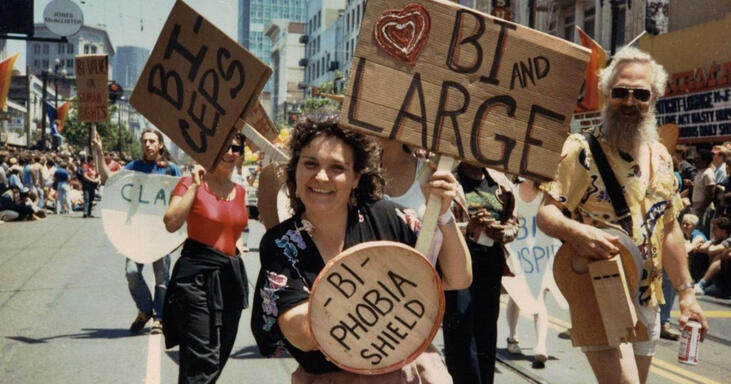
welcome to this carrd about historical definitions of bisexuality. this is a carrd version of this document which was compiled by @femmebisexuelle. I will not be featuring everything from that document on this carrd, so please check it out if you would like to do some further reading. this carrd was made by @sapphicbisexual.
all definitions are organized by date. please click any of the buttons to go to their respective time period.
70s

“Kate Millet concluded her December, 1974 talk: by lauding "the very wealth and humanity of bisexuality itself: for to exclude from one's love any entire group of human beings because of class, age, or race or religion, or sex, is surely to be poorer - deeply and systematically poorer.”
"The Bisexual Movement's Beginnings in the 70s", Stephen Donaldson, part of the book Bisexual Politics: Theories, Queries and Visions, edited by Naomi Tucket, 1995 (this in particular refers to 1974)
“Historian Martin Duberman (now head of the Center for Lesbian and Gay Studies at the City University of New York) took note in 1974 of the new visibility of bisexuality (he said that in 1973 he had written in his personal journal, "Bisexuals seem to be popping up all over.") and insightfully declared, "It's easier, I believe, for exclusive heterosexuals to tolerate (and that's the word) exclusive homosexuals than those who, rejecting exclusivity, sleep with people, not genders ....
To suggest, as practicing bisexuals do, that each of us may contain within ourselves all those supposed diametric opposites we've been taught to divide humanity into is to suggest that we might not know ourselves as well as we like to pretend.”
"The Bisexual Movement's Beginnings in the 70s", Stephen Donaldson, part of the book Bisexual Politics: Theories, Queries and Visions, edited by Naomi Tucket, 1995 (this, in particular, refers to 1974)
“Margaret Mead in her Redbook magazine column wrote an article titled ‘Bisexuality: What’s It All About?’ in which she cited examples of bisexuality from the distant past as well as recent times, commenting that writers, artists, and musicians especially ‘cultivated bisexuality out of a delight with personality, regardless of race or class or sex.’ ”
Janet Bode, “From Myth to Maturation,” part of the book View From Another Closet: Exploring Bisexuality in Women, 1976
“Being bisexual does not mean they have sexual relations with both sexes but that they are capable of meaningful and intimate involvement with a person regardless of gender.”
Janet Bode, “The Pressure Cooker,” part of the book View From Another Closet: Exploring Bisexuality in Women, 1976
“[John] reacted emotionally to both sexes with equal intensity. ‘I love people, regardless of their gender,’ he told me.”
Charlotte Wolff, “Early Influences,” Bisexuality, a Study, 1979
80s

“Bisexuality, however, is a valid sexual experience. While many gays have experienced bisexuality as a stage in reaching their present identity, this should not invalidate the experience of people for whom sexual & affectional desire is not limited by gender. For in fact, many bisexuals experience lesbianism or homosexuality as a stage in reaching their sexual identification.”
Megan Morrison, “What We Are Doing,” Bi Women: the newsletter of the Boston Bisexual Women's Network, 1984
“In the midst of whatever hardships we [bisexuals] had encountered, this day we worked with each other to preserve our gift of loving people for who they are regardless of gender.”
Elissa M., “Bi Conference,” Bi Women: the newsletter of the Boston Bisexual Women’s Network, 1985
"I believe most of us will end up acknowledging that we love certain people or, perhaps, certain kinds of people, and that gender need not to be a significant category, though for some of us it may be"
Ruth Hubbard, “There Is No ‘Natural’ Human Sexuality, Bi Women: the Newsletter of Boston Bisexual Women's Network, 1986
"I am bisexual because I am drawn to particular people regardless of gender"
Lani Ka'ahumanu, "The Bisexual Community: Are We Visible Yet?", 1987
“To be bisexual is to have the potential to be open emotionally and sexually to people as people, regardless of their gender.”
Office Pink Publishing, “Introduction,” Bisexual Lives, 1988
“We made signs and slashes. My favorite read, ‘When it’s love in all its splendor, it doesn’t matter what the gender.’”
Beth Reba Weise, “Being There and Being Bi: The National March on Washington for Lesbian and Gay Rights,” Bi Women: the Newsletter of Boston Bisexual Women's Network, 1988
90s

"Do not assume that bisexuality is binary or duogamous in nature [...] In fact, don’t assume that there are only two genders.”
The Bisexual Manifesto, 1990
“Bisexual usually also implies that relations with gender minorities are possible.”
“Many objections have been raised to the use of [“bisexual”], the most common being that it emphasizes two things that, paradoxically, bisexuals are the least likely to be involved with: the dualistic separation of male and female in society, and the physical implications of the suffix ‘-sexual’.”
Bisexuality: a Reader and Sourcebook, Thomas Geller, 1990
“Bisexuality works to subvert the gender system and everything it upholds because it is not based on gender… Bisexuality subverts gender; bisexual liberation also depends on the subversion of gender categories.”
Karin Baker and Helen Harrison, “Letters,” Bi Women: the Newsletter of Boston Bisexual Women's Network, 1990
“I tell them, whether or not I use the word ‘bisexual,’ that I am proud of being able to express my feelings toward a person, regardless of gender, in whatever way I desire.”
Naomi Tucker, “What’s in a Name?”, part of the book Bi Any Other Name, 1991
“Some women who call themselves ‘bisexual’ insist that the gender of their lover is irrelevant to them, that they do not choose lovers on the basis of gender.”
Marilyn Murphy, “Thinking About Bisexuality,” Bi Women: the Newsletter of Boston Bisexual Women's Network, 1991
“Results supported the hypothesis that gender is not a critical variable in sexual attraction in bisexual individuals. Personality or physical dimensions not related to gender and interaction style were the salient characteristics on which preferred sexual partners were chosen, and there was minimal grid distance between preferred male and preferred female partners. These data support the argument that, for some bisexual individuals, sexual attraction is not gender-linked. […] …the dimensions which maximally separate most preferred sexual partners are not gender-based in seven of the nine grids”
M. W. Ross, J. P. Paul, “Beyond Gender: The Basis of Sexual Attraction in Bisexual Men and Women”, 1992
“Bisexuals fall in love with a person, not a gender”
A bisexual’s survey response in Closer to Home: Bisexuality and Feminism, Weise, 1992
“[S]ome bisexuals say they are blind to the gender of their potential lovers and that they love people as people… For the first group, a dichotomy of genders between which to choose doesn’t seem to exist[.]”
Kathleen Bennett, “Feminist Bisexuality, a Both/And Option for an Either/Or World,” Closer to Home: Bisexuality and Feminism, 1992
“To be bisexual is to have the potential to be open emotionally and sexually to people as people, regardless of their gender”
Sex and Sexuality: A Thematic Dictionary of Quotations, 1993
“The expressed desires of [female bisexual] respondents differed in many cases from their experience. 37 respondents preferred women as sexual partners; 9 preferred men. 21 women had no preference, and 35 said they preferred sex with particular individuals, regardless of gender.”
Sue George, “Living as bisexual,” Women and Bisexuality, 1993
"Some of us are bisexual because we do not pay much attention to the gender of our attractions"
“The Natural Next Step”, Naomi Tucket, part of the book Bisexual Politics: Theories, Queries and Visions, edited by Naomi Tucket, 1995
“If anything, being bi has made me hyper-aware of the sexual differences between [men and women]. And I still get hot for both. But I do experience something that is similar to gender blindness. It’s this: being bisexual means I could potentially find myself sexually attracted to anybody. Therefore, as a bisexual, I don’t make the distinction that monosexuals do between the gender you fuck and the gender you don’t.”
“Bi Sexuality”, Greta Christina, part of the book Bisexual Politics: Theories, Queries and Visions, edited by Naomi Tucket, 1995
“I’m bi. That simply means I can be attracted to a person without consideration of their gender.”
E. Grace Noonan, “Out on the Job: DEC Open to Bi Concerns,” Bi Women: the Newsletter of Boston Bisexual Women's Network, 1996
"Bisexual - being emotionally and physically attracted to all genders.”
GLSEN, Out Of The Past guidebook, 1998
“A large group of bisexual women reported in a Ms. magazine article that when they fell in love it was with a person rather than a gender…”
Betty Fairchild and Nancy Hayward, “What is Gay?”, Now that You Know: A Parents’ Guide to Understanding Their Gay and Lesbian Children, 1998
2000s
“Respondent #658 said that both are irrelevant; ‘who I am sexually attracted to has nothing to do with their sex/gender,’ whereas Respondent #418 focuses specifically on the irrelevance of sex: I find myself attracted to either men or women. The outside appendages are rather immaterial, as it is the inner being I am attracted to. […] Respondent #495 recalled that “the best definition I’ve ever heard is someone who is attracted to people & gender/sex is not an issue or factor in that attraction.” […] As Respondent #269 put it, “I do not exclude a person from consideration as a possible love interest on the basis of sex/gender.” […] For most individuals who call themselves bisexual, bisexual identity reflects feelings of attraction, sexual and otherwise, toward women and men or toward other people regardless of their gender.”
Paula C. Rust, “Two Many and Not Enough: The Meanings of Bisexual Identities”, Journal of Bisexuality, 2000
“Giovanni’s distinction between what he wants and who he wants resonates with the language of many of today’s bisexuals, who insist that they fall in love with a person, not a gender.”
Marjorie Garber, Bisexuality and the Eroticism of Everyday Life (2000)
“The message of bisexuality — that people are more than their gender; that we accept all people, regardless of Kinsey scale rating; that we embrace people regardless of age, weight, clothing, hair style, gender expression, race, religion and actually celebrate our diversity — that message is my gospel. I travel, write, do web sites — all to let people know that the bisexual community will accept you, will let you be who you are, and will not expect you to fit in a neat little gender/sexuality box.”
Wendy Curry, “Celebrating Bisexuality,” Bi Women: the Newsletter of Boston Bisexual Women's Network, 2000
“But really, just like I can’t believe in the heterosexist binary gender system, I have difficulty accepting wholeheartedly any one spiritual tradition.”
Anonymous, “A Methodical Awakening,” Bi Women: the Newsletter of Boston Bisexual Women's Network, 2002
“But there are also many bis, such as myself, for whom gender has no place in the list of things that attract them to a person. For instance, I like people who are good listeners, who understand me and have interests similar to mine, and I am attracted to people with a little padding here and there, who have fair skin and dark hair (although I’m pretty flexible when it comes to looks). ‘Male’ or ‘female’ are not anywhere to be found in the list of qualities I find attractive.”
Bisexual Basis, Karin Baker, 2002
“Bisexual people are those for whom gender is not the first criteria in determining attraction.”
Sexual Orientation, Gender Identity and Youth Suicide, Illinois Department of Public Health, 2003
“Bisexual: A person who is attracted to people regardless of gender (a person does not have to have a relationship to be bisexual!)”
Bowling Green State University, “Queer Glossary”, 2003
“The bisexual community seems to be disappearing. Not that there won’t always be people around who like to have sex with people of all genders, the community, as I’ve discussed in this book, is a different matter altogether.”
William Burleson, Bi America: Myths, Truths, and Struggles of an Invisible Community, 2005
“I introduce myself as bisexual, because I am attracted to people, across gender lines, and ‘bisexual’ comes closest to explaining that.”
B.J. Epstein, “Bye Bi Labels,” Bi Women Quarterly vol 27 no.3, 2009
2010s
“To me, being bisexual means having a sexuality that isn’t limited by the sex or gender of the people you are attracted to. You just recognize that you can be attracted to a person for very individual reasons.”
Deb Morley, “Bi of the Month: An Interview with Ellyn Ruthstorm,” Bi Women: the Newsletter of Boston Bisexual Women's Network, 2010
“Q: Which gender person does a bisexual love?
A: Any gender she wants.”
Marcia Deihl, “Do Clothes Make the Woman?”, Bi Women, : the Newsletter of Boston Bisexual Women's Network, 2010
“I am bisexual. That does not depend on my dating experience or my attraction specifications. It is not affected by my dislike for genitals (of any shape). All it describes is how gender affects attraction for me: it doesn’t. I am attracted to people regardless of gender, and I am bisexual.”
Emma Jones, “Not Like the Others,” Bi Women Quarterly vol 31 no.4, 2013
“I’m generally okay with ‘attraction to more than one gender’ [as a definition of ‘bisexuality’]. I think that the ‘more than’ part is important because there are definitely more than two genders. Some people like the definition ‘attraction regardless of gender’ and I like that too because it suggests that things other than gender can be equally, or more, important in who we are attracted to. I like to question why our idea of sexuality is so bound up with gender of partners. Why not encompass other aspects such as the roles we like to take sexually, or how active or passive we like to be, or what practices we enjoy? Why is our gender, and the gender of our partners, seen as such a vital part of who we are?”
Robyn Ochs, “Around the World: Meg Barker,” Bi Women Quarterly vol 31 no.4, 2013
“It may sound crazy but I’d never thought that carefully about the ‘bi’ part of the word meaning ‘two’. I’d always understood bisexuality to mean what Bobbie Petford reports as the preferred definition from within the UK bi communities: changeable ‘sexual and emotional attraction to people of any sex, where gender may not be a defining factor’. […] Participants in the BiCon discussion rejected the ‘you are a boy or you are a girl…binary’ (Lanei), all arguing that they were not straightforwardly ‘masculine’ or ‘feminine’.
“Bisexuality & Gender,” Bi Community News, 2014
“It is the job of those of us with links to children to continue to promote the language of bisexuality and validity of attraction to all genders — especially when that attraction changes over time.”
Bethan, “Practical Bi Awareness: Teaching and LGBT,” Bi Community News, 2016
“I call myself bisexual because it includes attraction to all genders (same as mine; different from mine). I call myself bisexual because it’s a label with a long, honorable history. Bisexual people have been at the forefront of LGBTQ liberation movements from their earliest days. I don’t want to negate that history or dishonor my foremothers and forefathers by claiming some new, trendy label for myself.”
Rev. Francesca Bongiorno Fortunato, Bi Women Quarterly vol.34 no. 3, Summer 2016
“Robyn Ochs states where the EuroBiCon also stands for: bisexuality goes beyond the binary gender thinking. There are more genders than the obsolete idea of two: male and female.”
Erwin, “Robyn Ochs: ‘Bisexuality goes beyond the binary gender thinking’,” European Bisexual Conference, 2016
“Loving a person rather than a man or a woman: this is Runa Wehrli’s philosophy. At 18, she defines herself as bisexual and speaks about it openly. […] She believes that love should not be confined by the barriers put up by society. ‘I fall in love with a person and not a gender,’ she says. […] Now single and just out of high school, she is leaving the door open to love, while still refusing to give it a gender.”
Katy Romy, “‘I fall in love with a person and not a gender’,” Swissinfo, 2017
“Being bisexual does not assume people are only attracted to just two genders. Bisexuality can be limitless for many and pay no regard to the sex or gender of a person.”
The Bi+ Manifesto, 2018
“I realized I was bisexual at age fifteen, but although I am attracted to folks of any gender, I’ve always had a preference for men.”
Mark Mulligan, “Fight and Flight: ‘Butch Flight,’ Trans Men, and the Elusive Question of Authenticity,” Nursing Clio, 2018
“Bisexuality just became, to me, about that openness — that openness to anything, and any potential to any type of relationship, regardless of gender. Gender is no longer a disqualifier for me. It’s about the person.”
Rob Cohen, “Where Are All the Bi Guys?,” Two Bi Guys, 2019
“Oh no, Mom. I’m not a lesbian. Actually, I’m bisexual. That means that gender doesn’t determine whom I’m attracted to.”
Annie Bliss, “Older and Younger,” Bi Women Quarterly vol. 37 no. 4, 2019
2020s
“It’s OK to be attracted to multiple genders and even people outside of gender. It’s more than OK, it’s beautiful. Being bisexual is not something to hide because I am in a place where I can safely say, I am an out bisexual man and I will never go back in that closet again.”
David Kaye, writer and musician, on the article “12 People Share How They Knew They Were Bisexual” by Brittany Wong, Huffpost.com, 2020
"If you're thinking that these all sound super similar, you're not wrong; the takeaway from all of them is that "bisexual" means you're not only attracted to one gender. The difficulty is when a definition implies or assumes that there are only two genders, male and female (but more on that in a sec)."
Gabrielle Kassel, on the article "What Bisexuality Means, Doesn't Mean, and How to Know If You're Bi", Shape, 2020
"Now, bisexuality is defined as the sexual and/or romantic attraction to people of the same gender and otherwise."
"Bisexuality: What it means and signs to look out for", Times Of India, 2020
"Bisexuality can mean different things, and not everyone will agree on a single definition. Generally, if someone identifies as bisexual, they feel an attraction to more than one gender."
"Differences between bisexuality and pansexuality", MedicalNewsToday, 2020
"Nowadays, “bisexuality is defined as the sexual and/or romantic attraction to people who are of the same gender and people who have a different gender than your own,” she says."
Gabrielle Kassel, on the article "‘Am I Bisexual?’ 18 Signs According To Experts And Real Women", Women's Health, 2020
date unknown
"Bisexuality is not limited by sex nor, by extension, by gender. Imposing gender limitations upon bisexuality is, in itself, a form of bi erasure."
“Bisexuality is an identity for which sex and gender are not a boundary to attraction. Heterosexuality and homosexuality, on the other hand, are defined by the boundary of two sexes/genders. Given those fundamental facts, any talk of bisexuality reinforcing a gender binary is misplaced. Over time, our society’s concept of human sex and gender may well change. For bisexuals, people for whom sex/gender is already not a boundary, any such change would have little effect. Why then, would bisexuality be even remotely to blame for reinforcing a “false gender binary?”
Bi.org (date unknown)
“Please also note that attraction to both same and different means attraction to all. Bisexuality is inherently inclusive of everyone, regardless of sex or gender.
In everyday language, depending on the speaker’s culture, background, and politics, that translates into a variety of everyday definitions such as:
Attraction to men and women
Attraction to all sexes or genders
Attraction to same and other genders
Love beyond gender
Attraction regardless of sex or gender”
“What Is Bisexuality?,” Bi.org (date unknown)
“Assuming that all bisexuals are never attracted to trans or genderqueer folk is harmful, not only to bi individuals, but to trans and genderqueer individuals who choose to label themselves as bi.”
BiResource (date unknown)
“My own understanding of bisexuality has changed dramatically over the years. I used to define bisexuality as ‘the potential to be attracted to people regardless of their gender.’ […] Alberto is attracted to the poles, to super-masculine guys and super-feminine girls. Others are attracted to masculinity and/or femininity, regardless of a person’s sex. Some of us who identify as bisexual are in fact ‘gender-blind.’ For others — in fact for me — it’s androgyny or the blending of genders that compels.”
Robyn Ochs, “What Does It Mean to Be Bi+?”, Bisexual Resource Center, (date unknown)